
Jaeger Adapter
@openplait/adapter-jaeger talks to Jaeger's Query HTTP API (/api/services,
/api/traces, /api/traces/{id}). Jaeger has no TraceQL equivalent — semantic
search is service-scoped and returns normalized span rows (including span events
mapped from Jaeger logs).
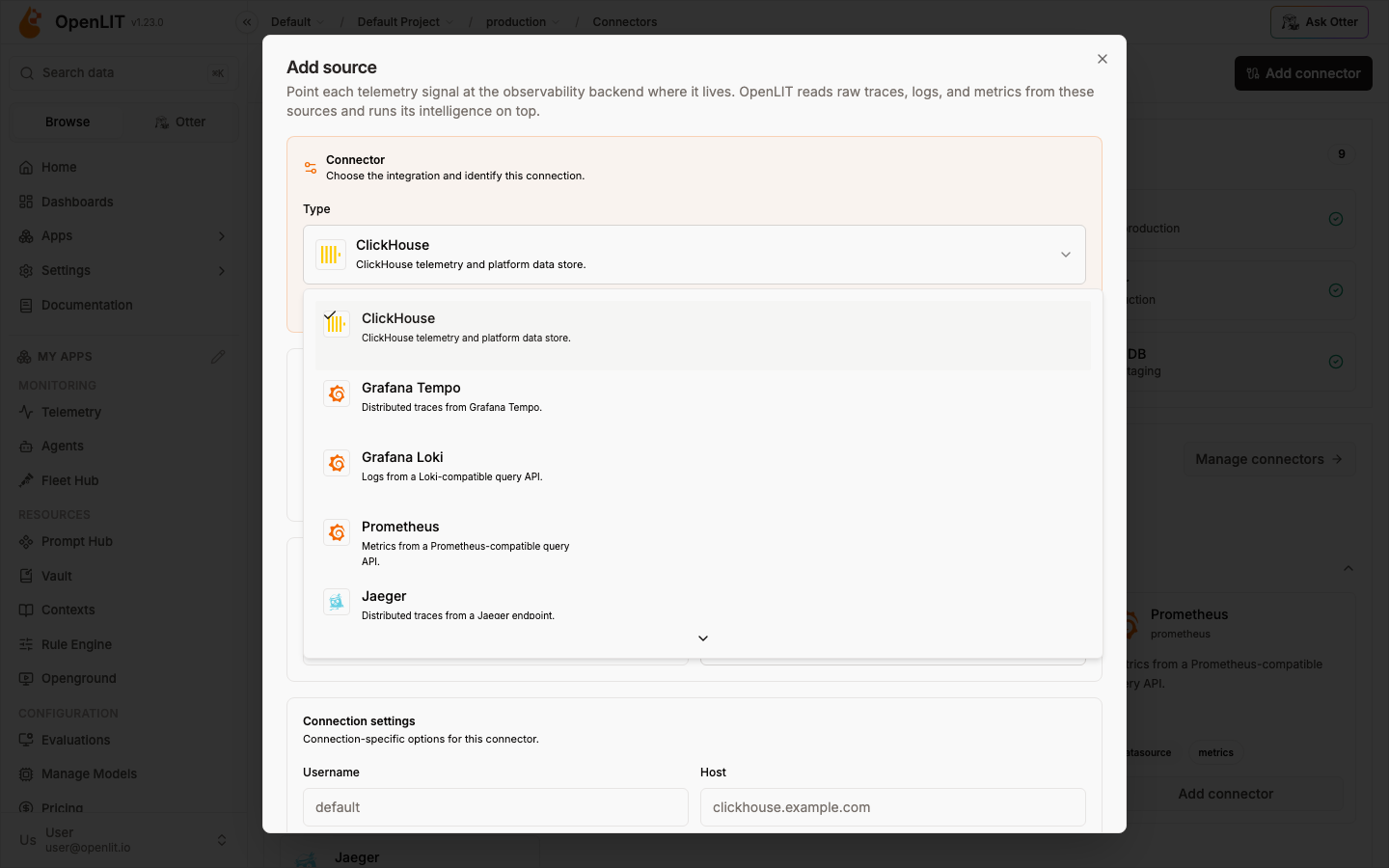
In OpenLIT, Jaeger is a project connector: create/select a project, add a Jaeger connector under Connectors, then bind traces to it for an environment. See the OpenLIT Connectors and Projects guides.
Configure
import { JaegerAdapter } from "@openplait/adapter-jaeger";

const adapter = new JaegerAdapter({
  url: "http://localhost:16686",
  // Optional when discovery is blocked; otherwise `/api/services` is used.
  // services: ["checkout", "payments"],
  bearerToken: process.env.JAEGER_TOKEN,
  maxResultRows: 1_000,
  perServiceLimit: 100,
});
Authentication options are bearer token, username/password, or custom HTTP
headers. When the Query UI is mounted under /jaeger, listServices() retries
with that path prefix and exposes the resolved base via adapter.resolvedUrl.
Semantic trace search
Search uses signal traces and dataset jaeger.traces. A service.name equals
filter is required because Jaeger's search API is service-scoped:
const traces = {
  apiVersion: "openplait.io/v1alpha1",
  kind: "Query",
  metadata: { name: "checkout-spans" },
  spec: {
    mode: "semantic",
    datasource: { kind: "JaegerDatasource", name: "jaeger-local" },
    input: { signal: "traces", entity: "jaeger.traces" },
    timeRange: { field: "timestamp", from: "${__from}", to: "${__to}" },
    select: [
      { field: "trace.id" },
      { field: "span.id" },
      { field: "service.name" },
      { field: "span.name" },
      { field: "duration" },
    ],
    where: {
      and: [{ field: "service.name", operator: "equals", value: "checkout" }],
    },
    limit: 100,
  },
};

const compiled = await adapter.compile(traces, {
  variables: {
    __from: "2026-08-05T00:00:00.000Z",
    __to: "2026-08-05T01:00:00.000Z",
  },
});
const result = await adapter.execute(compiled, { audit: { requestId: "req-1" } });
Helpers for product hosts that fan out across services:
const services = await adapter.listServices();
const raw = await adapter.searchTraces({
  service: "checkout",
  startMs: Date.now() - 3_600_000,
  endMs: Date.now(),
  limit: 50,
});
const spans = adapter.normalizeSpans(raw);
const one = await adapter.getTrace("0123456789abcdef0123456789abcdef");
Local development
cd typescript/packages/adapter-jaeger/test/integration
docker compose up -d
./seed-traces.sh
curl -s 'http://localhost:16686/api/services' | jq
| Endpoint | Purpose |
|---|---|
http://localhost:16686 | Jaeger UI + Query HTTP API |
http://localhost:4318 | OTLP HTTP ingest for seeding |
OpenLIT connector
OpenLIT wraps this package for guarded HTTP, vault secrets, AI-selector filtering, and in-process aggregates:
- Open Organisation → Project → Connectors
- Add Jaeger with URL
http://localhost:16686(no auth for local all-in-one) - Bind traces to that connector for the environment
- Open Telemetry — AI spans from the seed script appear under
openlit-demo
See also OpenLIT Integration.