
OpenLIT Integration
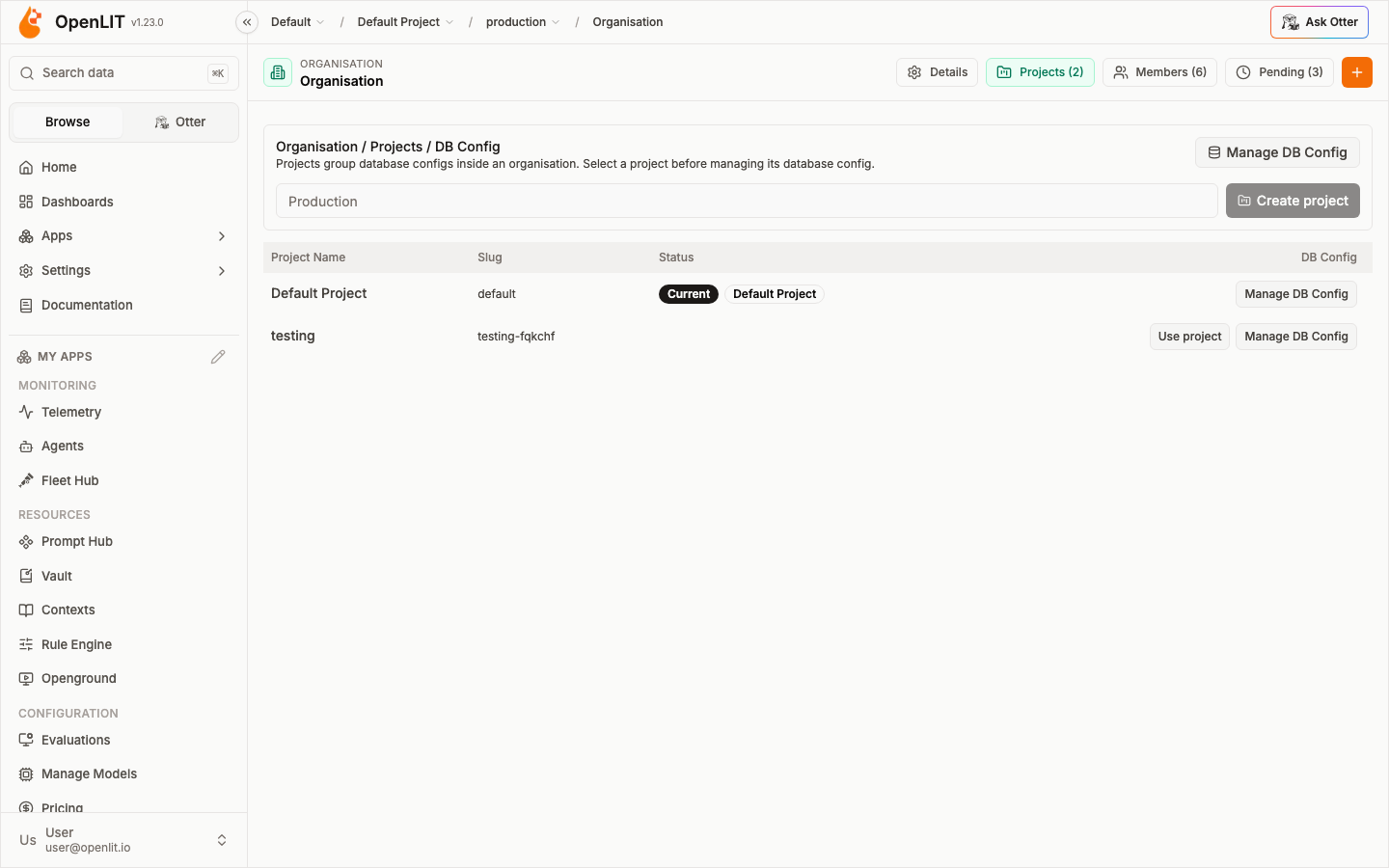
OpenLIT is an initial consumer of OpenPlait, not a dependency of the core contract. In OpenLIT, adapters are wired through project-scoped resources:
- Create/select a project
- Add a Database Config (ClickHouse) and/or connectors on that project
- Bind signals per environment
Product docs (Mintlify):
- Projects — owns Database Configs and connectors
- Database Config — ClickHouse on the project
- Connectors — Tempo, Loki, Prometheus, Jaeger
- Signal routing — per-signal bindings
npm packages OpenLIT incorporates
npm install @openplait/core \
  @openplait/adapter-sdk \
  @openplait/adapter-clickhouse \
  @openplait/adapter-tempo \
  @openplait/adapter-loki \
  @openplait/adapter-prometheus \
  @openplait/adapter-jaeger \
  @openplait/runtime
| OpenLIT connector | OpenPlait package |
|---|---|
| ClickHouse (Database Config) | @openplait/adapter-clickhouse + runtime |
| Grafana Tempo | @openplait/adapter-tempo |
| Grafana Loki | @openplait/adapter-loki |
| Prometheus | @openplait/adapter-prometheus |
| Jaeger | @openplait/adapter-jaeger |
| Query planning / multi-query | @openplait/runtime |
See PUBLISHING.md for releasing @openplait/* on npm.
ClickHouse / Database Config
OpenLIT builds a shared OpenPlaitRuntime from the active Database Config
(not from live INIT_DB_* env vars after seed) and OpenLIT dataset mappings.
Telemetry, rules, evaluations, dashboards, and analysis submit portable queries
against that runtime. Derived intelligence always stays on ClickHouse even when
raw traces/logs/metrics are rebound to external connectors.
Tempo
OpenLIT's Tempo connector delegates to @openplait/adapter-tempo:
- bounded TraceQL trace search
- full trace-by-ID retrieval and OTLP span normalization
- span lookup through search + detail retrieval
- Tempo v2 tag-value and service discovery
OpenLIT retains vault secrets, tenant/project checks, SSRF-safe HTTP transport, caching, concurrency limits, and product-specific TraceQL metrics aggregation.
const openPlaitTempo = new TempoAdapter(
  {
    url: descriptor.settings.url,
    httpHeaders: resolvedAuthHeaders,
    allowNativeQueries: true,
    maxResultRows: 200,
    maxTimeRangeMs: THIRTY_ONE_DAYS,
  },
  { fetch: openLitGuardedFetch },
);
The selected traces binding supplies the Tempo URL and credentials. Choosing a different Tempo connector constructs a different adapter; OpenLIT does not silently fall back to ClickHouse unless resolution order reaches the built-in Database Config.
Loki, Prometheus, and Jaeger
- Loki (
@openplait/adapter-loki) — LogQL reads for the logs binding. - Prometheus / Mimir (
@openplait/adapter-prometheus) — PromQL for the metrics binding. - Jaeger (
@openplait/adapter-jaeger) — service-scoped Query HTTP search for the traces binding; OpenLIT keeps AI-selector filtering and in-process aggregates on top.
Signal routing in OpenLIT decides which connector (hence which adapter instance) serves each signal for a project environment.
Security boundary
Credentials never live inside OpenPlait packages. OpenLIT resolves vault secrets
server-side, injects headers into adapter config, and enforces endpoint allowlists
before fetch reaches the vendor.